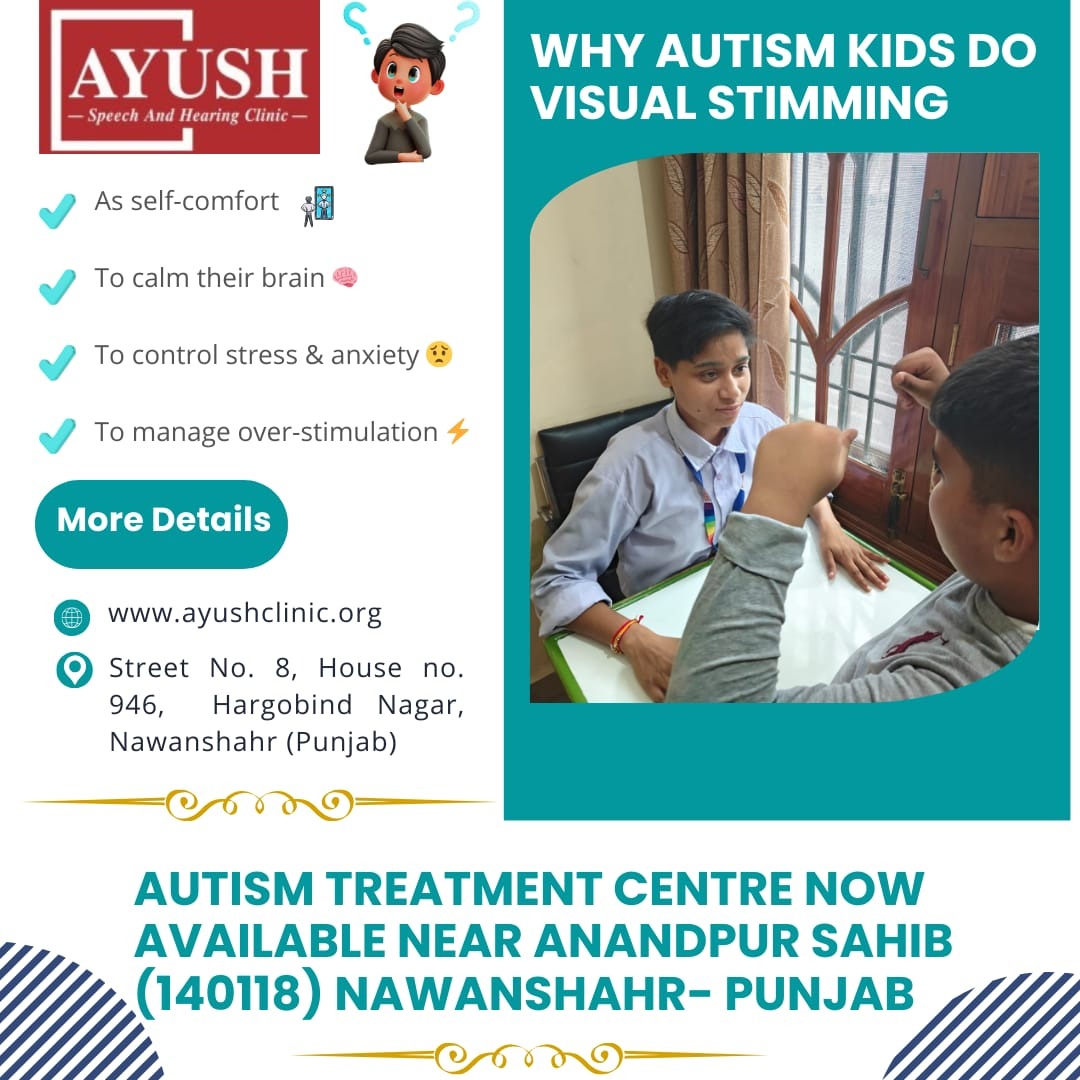
What is Visual Stimming?
As we know, autistic children often display different behaviors such as hand flapping, toe walking, repetition, avoiding eye contact, not responding to their name, hyperactivity, lack of communication, and poor social interaction. Among these behaviors, one common pattern is Visual Stimming.
What Does Visual Stimming Mean?
Visual stimming refers to behaviors in which a child uses their eyes or eye movements in a repetitive manner that brings them comfort or relaxation.
For example, many autistic children bring their fingers close to their eyes, wave them, and look at them very carefully. Such repetitive visual behaviors are known as visual stimming.
Why Do Autistic Children Do Visual Stimming?
Self-Soothing
Visual stimming helps children feel calm, balanced, and relaxed.
Excitement or Anxiety
Communication Difficulty
Since many autistic children are non-verbal and cannot express their needs through speech, visual stimming may be a way to communicate or express emotions.
Sensory Issues
Autism children may either have hypo-sensitivity (low response to visual input) or hyper-sensitivity (high response to visual input).
Based on these, they show different types of behaviors.
Hyper-Sensitivity (Seeking More Visual Input)
Children with hyper-sensitivity enjoy visual stimulation and show behaviors such as
Lining up objects – Arranging things in a line and watching them repeatedly from the corner of the eye. If the line is disturbed, they may get upset or cry.
Hand and finger movements – Moving fingers in front of the eyes, fluttering them, and watching carefully.
Shadow watching – Looking at their own shadow, chasing it, and enjoying it.
Watching rotating things – Always attracted to rotating objects such as a spinning fan, moving tires, or stirring tea.
Hypo-Sensitivity (Avoiding Visual Input)
Children with hypo-sensitivity avoid visual stimulation and show opposite behaviors, such as:
Fear of light – They get scared or hyper when exposed to bright light or flashlights.
Looking from the corner of the eye – They avoid direct eye contact and prefer to see objects from the side.
Excessive blinking – Repeated blinking to avoid too much light entering their eyes.
Squinting – Keeping eyes half-closed, especially in sunlight or bright areas, to reduce visual exposure.
Covering the eyes – Using hands or hair to cover the eyes and avoid bright light.
How Can Parents Understand Visual Stimming?
If your child shows frequent visual stimming behaviors, the first step is to identify whether it is due to hyper-sensitivity or hypo-sensitivity.
By observing the patterns mentioned above, you can understand your child’s needs better. This understanding is very important in autism therapy, as it helps parents and therapists create the right strategies for the child’s sensory and behavioral development.
There are many reasons why autistic children show visual stimming
behaviors, especially seen in autism therapy cases in Nawanshahr
Understanding why children with autism engage in visual stimming is
important for parents seeking autism therapy in Nawanshahr
Autistic children may display visual stimming for different reasons,
which parents in Nawanshahr should be aware of during therapy and care