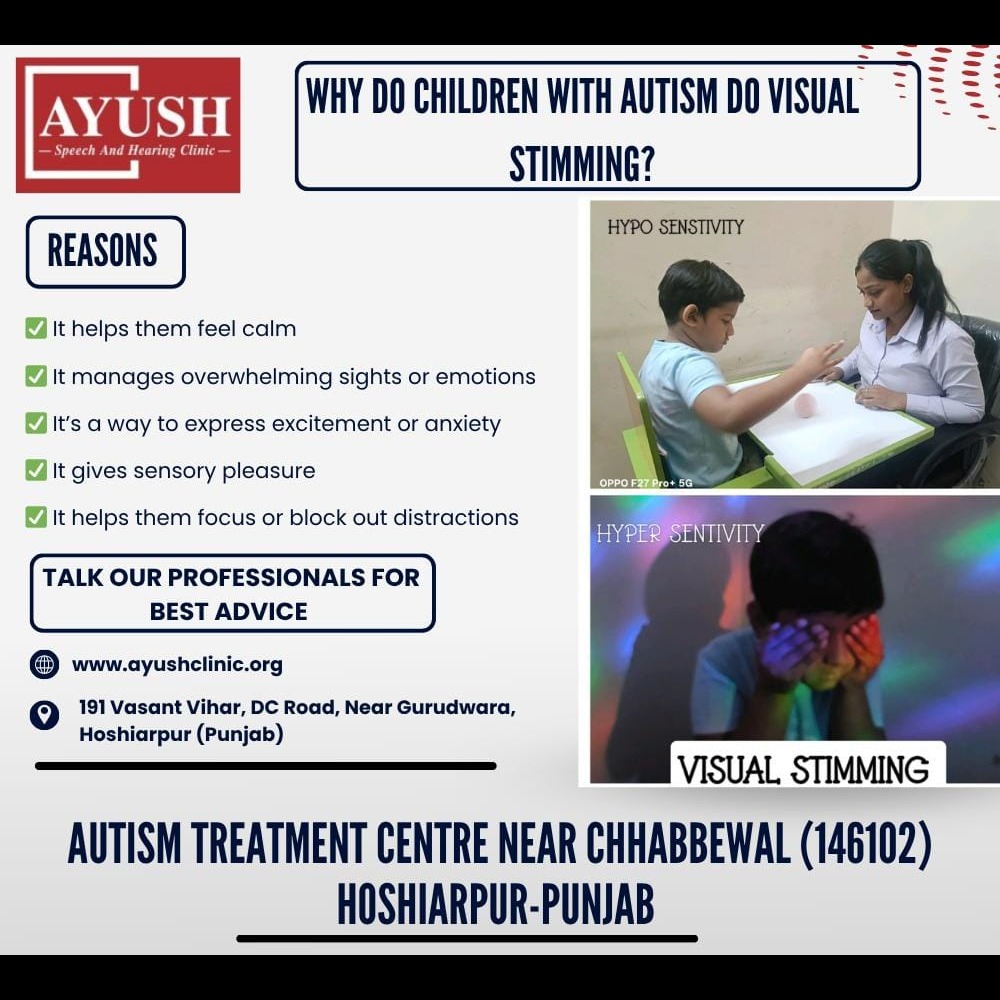
What is Visual Stimming? Why Do Children with Autism Exhibit Visual Stimming?
Discover what visual stimming is and why children with autism engage in it. Learn how sensory issues affect autistic behavior and how Ayush Speech and Hearing Clinic offers expert autism therapy in Hoshiarpur.
Autism Therapy in Hoshiarpur
Autism is a neurodevelopmental disorder, but if we understand it deeply, it's primarily a coordination issue. Our body has five primary senses: auditory, visual, olfactory, gustatory, and tactile. When these senses fail to coordinate properly, children may exhibit unusual behaviors. These behaviors include hand flapping, toe walking, lack of eye contact, and repetitive actions. One of these behaviors is called Visual Stimming.
Autism treatment center in Hoshiarpur
What is Visual Stimming?
Children with autism often display a variety of unique behaviors. Not every child shows the same traits — each child has individual needs and patterns of behavior. Some behaviors may seem strange or socially awkward, which can cause stress for parents, especially when in public. As a result, many parents start avoiding social situations, which can harm the child’s development.
Visual Stimming is one such behavior.
In visual stimming, children become highly fascinated with lights and visual patterns. A child may stare intensely at a light source for long periods or flap their fingers rapidly in front of their eyes to enjoy the light patterns created by the motion. They may frequently turn the fan on and off, not for cooling, but to watch the changing light patterns caused by the movement.
Other examples include
Spinning themselves or objects continuously
Viewing things from unusual angles (like turning the head sideways)
Watching hair move in front of their eyes
Lining up objects and watching light between the gaps
Focusing on corners or specific edges and expressing happiness
Becoming so excited that they start flapping their hands or shaking their entire body
These are all signs of visual stimming.
Best autism therapy clinic Hoshiarpur
Why Do Children with Autism Engage in Visual Stimming?
The core reason behind visual stimming is sensory processing issues.
There are two types of sensory sensitivity:
Hypo-sensitivity (sensory-seeking behavior)
Hyper-sensitivity (sensory-avoidant behavior)
Hypo-Sensitivity
In hypo-sensitivity, the child constantly seeks visual input. They enjoy:
Watching flashing lights
Spinning objects and toys
Moving sticks or wires rapidly in front of their eyes
Spinning themselves or circling objects
Many parents are surprised by their child’s ability to spin things so expertly. These behaviors are a way for hypo-sensitive children to fulfill their sensory needs.
Hyper-Sensitivity
In hyper-sensitivity, the child avoids bright lights or overwhelming visuals. You may notice:
Aversion to sudden lights
Crying or panicking when a flashing light is turned on
Covering eyes with hair or hands
Looking at things from the corner of their eyes
Frequent blinking or squinting to reduce light exposure
Both types of sensitivity—hypo- and hyper—can lead to visual stimming behaviors.
At Ayush Speech and Hearing Clinic, Hoshiarpur, we specialize in understanding and treating sensory behaviors like visual stimming in children with autism. Our experienced therapists use child-friendly and research-based approaches to help children manage their sensory challenges, improve focus, and participate more fully in daily life.
Conclusion
Visual stimming is a sensory behavior seen in children with autism, caused by either a craving for or an aversion to visual input. By observing these behaviors, parents and therapists in Hoshiarpur can better understand a child’s sensory profile and work on targeted therapy strategies to help the child grow and adapt comfortably.
Speech and occupational therapy for autism